
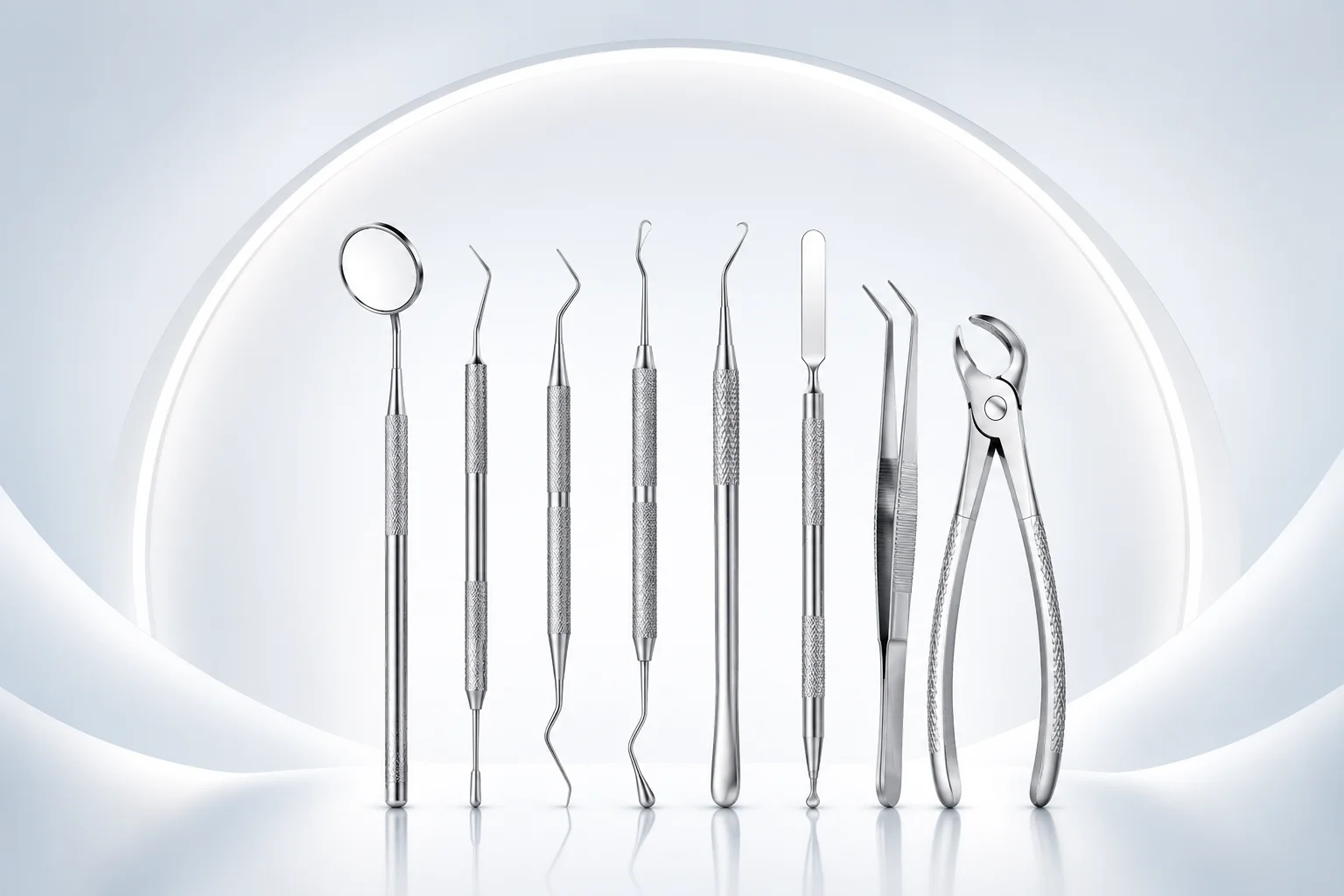
Used during routine prophylaxis to remove supragingival stain and calculus from buccal and facial surfaces of all dentition. The hygienist scaler’s balanced design supports fulcrum stability when scaling the maxillary molars from the palatal approach. It is well suited for maintenance patients with generalized gingivitis who require thorough coronal polishing after debridement.
Used during third-molar extractions and other posterior oral surgery to retract the buccal mucosa away from the mandibular ramus and retromolar pad. The broad Minnesota blade keeps soft tissue clear of the surgical site while the surgeon luxates and elevates impacted teeth. It also improves visualization when placing sutures along the posterior vestibule.
Applied when encountering tenacious subgingival and supragingival deposits on teeth with heavy tobacco staining or long-standing neglect. The Super Taha scaler’s robust shank transmits controlled force to fracture calcified ledges on the cementoenamel junction of posterior teeth. Periodontal therapists select this instrument during initial phase therapy for patients with advanced calculus formation.
Employed in dental and maxillofacial suites to grip, bend, and seat intermaxillary fixation wire around arch bars or eyelets. The narrow jaws reach into the buccal vestibule to adjust wire loops without traumatizing gingiva during mandibular fracture wiring. Clinicians also use it to contour retention wires for splinting avulsed or luxated anterior teeth.
Used to smooth and condense amalgam or composite restorations after initial packing into Class I and Class II cavity preparations. The ball tip burnishes occlusal anatomy into premolar and molar restorations before final carving with a cleoid-discoid. It also polishes marginal ridges to reduce post-operative sensitivity from overhanging composite flash.
Applied when tightening twisted stainless-steel ligature wire across dental arch bars during IMF procedures in the oral surgery setting. The ratchet lock maintains tension while the clinician completes a figure-eight twist at the mandibular angle or zygomatic buttress. It is also useful for securing orthodontic stabilization wire after trauma splinting.
Employed to scoop softened carious dentin from the floor and walls of cavity preparations after caries-detector staining. The spoon-shaped blade removes infected dentin while preserving the peripheral seal zone in deep lesions approaching the pulp. Restorative dentists use paired excavators to refine line angles before placing bonded composite or glass ionomer bases.
Used chairside to grasp cotton pellets, gauze, and articulating ribbon for placement into cavity preparations and sulcular areas. The serrated jaws hold dressing material securely while the dentist packs retraction cord or applies hemostatic agents before impression taking. Its angled beaks allow access to distal surfaces of molars during restorative procedures.
Used to place and adapt light-cured composite resin into Class III and Class V preparations along the cervical third of anterior teeth. The flexible plastic blade minimizes scratching of finished enamel while contouring composite to match the emergence profile. Its non-stick surface helps pack flowable composite into narrow proximal boxes without pulling material away from the matrix.
Mounted on a mirror handle to provide indirect vision of lingual and palatal tooth surfaces during comprehensive oral examinations. The cone-socket design allows rapid mirror head exchange when switching between adult and pediatric sizes mid-appointment. Hygienists rely on these mirrors to inspect interproximal plaque and early interproximal caries on posterior teeth.