
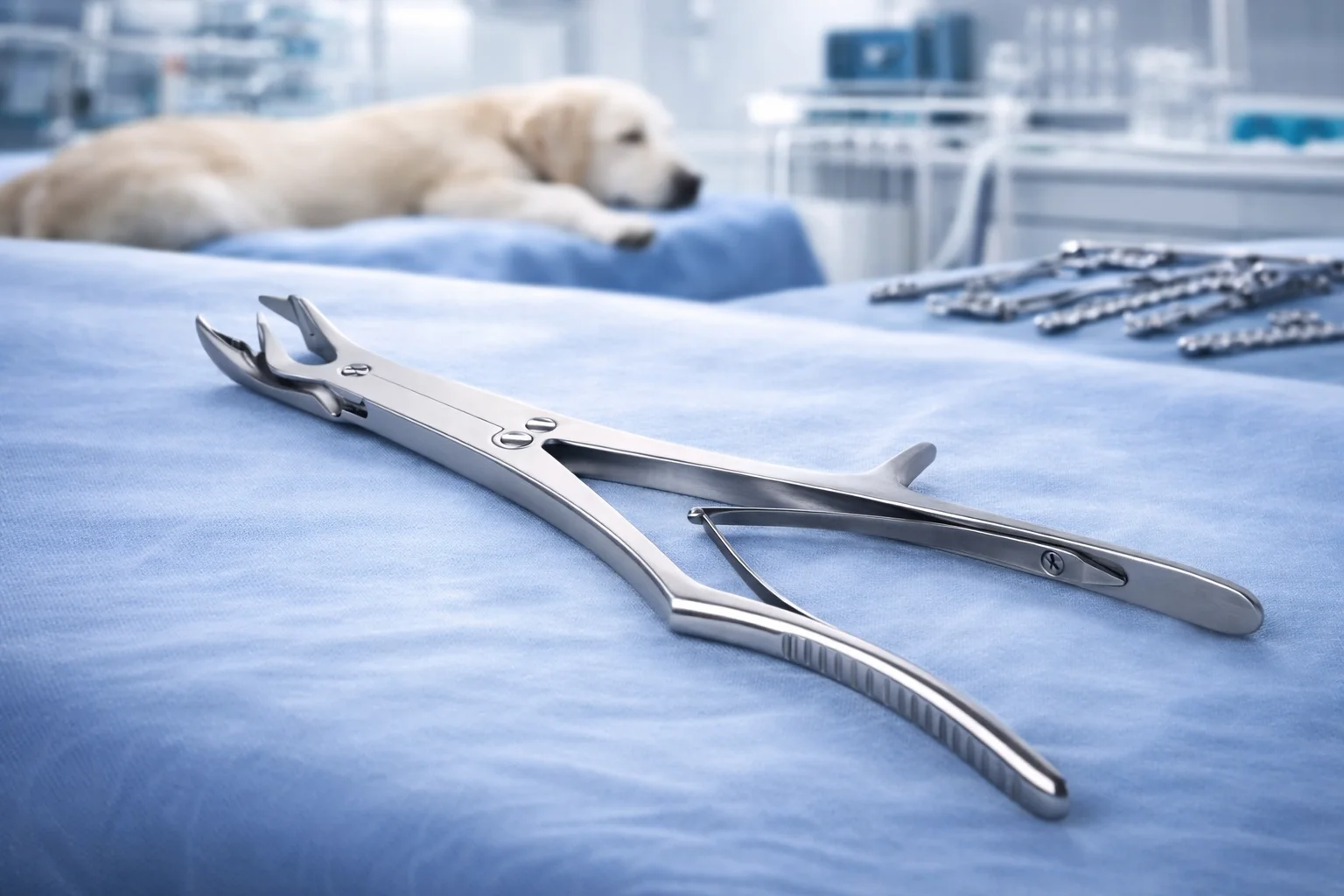
Holds a bone plate flush against the lateral cortex of the tibia or femur while the surgeon drills the first screw holes in comminuted diaphyseal fractures. The angled jaw and speed-lock ratchet maintain plate position without an assistant during minimally staffed cases. Orthopedic teams use it to prevent plate toggle when reducing butterfly fragments along the fracture line.
Used during open reduction of pelvic ring injuries to measure and maintain the anatomic distance between iliac wings and sacral promontory. The calibrated scale allows the surgeon to document restoration of pelvic width before applying anterior plates or external fixation pins. It assists in reducing rotationally unstable pelvic fractures by providing visual feedback on symmetric alignment.
Employed to compress and align the anterior pelvic ring during symphyseal plating and acetabular fracture approaches through the ilioinguinal incision. The caliper jaws span the pelvic brim to reduce diastasis of the pubic symphysis before screw fixation. Pelvic surgeons use the integrated measurement scale to confirm anatomic reduction against preoperative templating.
Used to seat and advance spinal or long-bone fixation rods into pedicle screw tulips and external fixator clamps during construct assembly. The pistol-grip handle directs axial force along the rod axis when contouring rods to match lumbar lordosis. Spine surgeons employ it to reduce spondylolisthesis by pushing the rod into the screw heads before set screw tightening.
Contours reconstruction plates to match the anatomy of the clavicle, distal radius, and proximal humerus before intraoperative application. The set includes pliers for in-plane and out-of-plane bending so the plate sits flush against the bone surface without gapping. Orthopedic technicians and surgeons use it during ORIF when pre-contoured plates require final adjustment at the fracture site.