
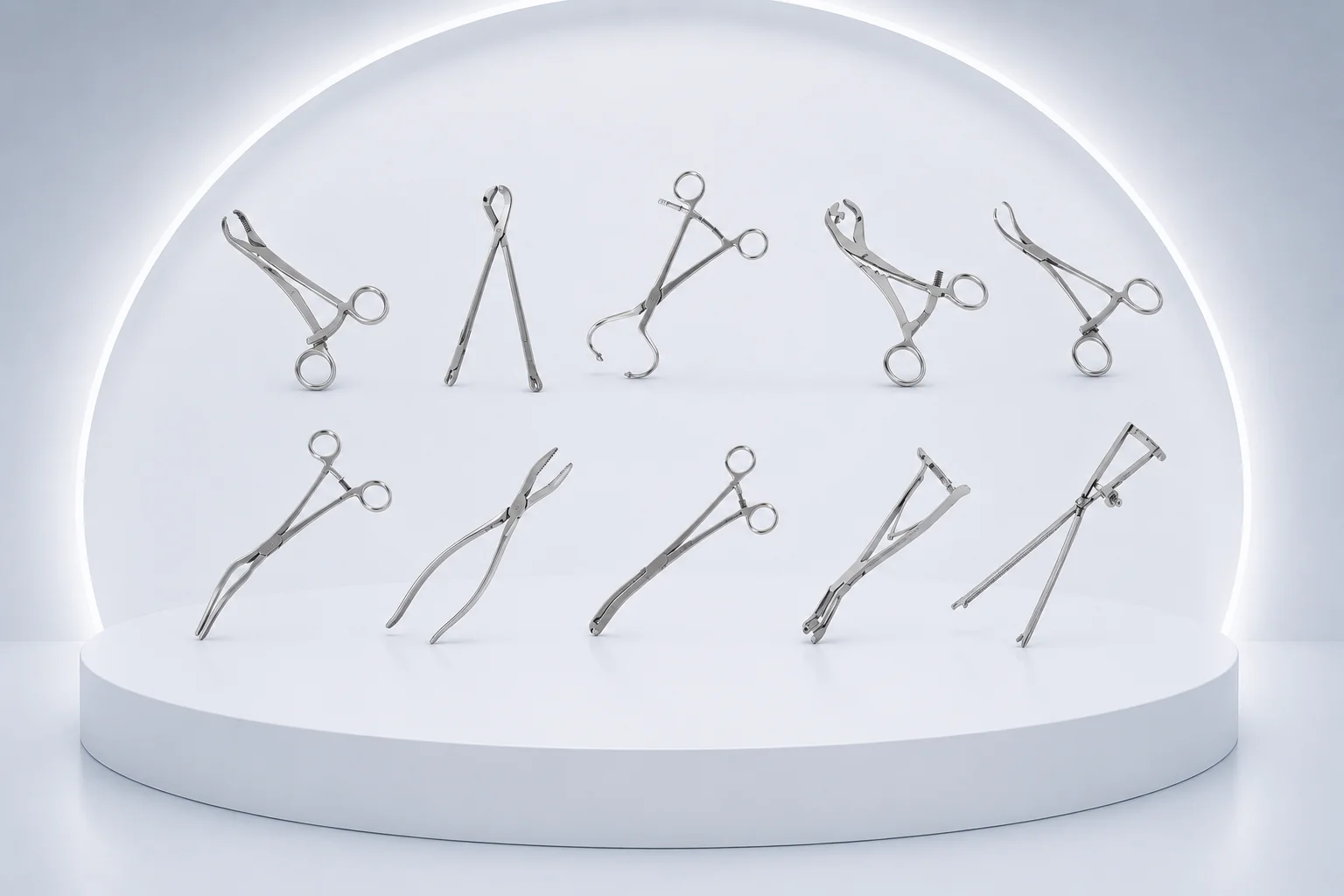
Grasps fracture fragments at an oblique angle during reduction of metadiaphyseal tibia and distal radius fractures where straight forceps cannot achieve perpendicular purchase. The speed-lock ratchet maintains compression across the fracture while the surgeon drills and inserts lag screws. Its angled jaws facilitate reduction in confined wound corridors created by minimally invasive plate osteosynthesis.
Temporarily clamps bone segments or plate-bone constructs during complex periarticular fracture fixation when multiplanar alignment must be held. The articulated joint allows the surgeon to adjust the clamp angle to match the fracture obliquity at the distal femur or proximal tibia. It serves as a third hand while definitive screws are placed through a locking compression plate.
Used to compress transverse and short oblique fractures of the fibula and ulna where serrated jaws prevent cortical slippage during clamp closure. The speed-lock bar locks the forceps at the desired compression distance while the surgeon inserts an interfragmentary lag screw. Orthopedic teams deploy this pattern when reducing simple diaphyseal fractures before neutralization plating.
Applied when gradual, incremental compression is needed across a fracture gap in the humeral shaft or clavicle before plate application. The threaded speed-lock mechanism allows the surgeon to advance compression in controlled steps without releasing the bone hold. It is favored for reducing gaps in delayed union cases where excessive single-step compression could shorten the limb.
Employed in elective orthopedic ORIF to maintain fracture reduction with a highly visible gold handle that distinguishes the instrument from the standard tray layout. The speed-lock mechanism secures compression across the femoral or tibial fracture while lag screws are inserted over a pointed reduction clamp. Attending surgeons often reserve gold-handle forceps for teaching cases where instrument identification speeds the workflow.
Used for reduction and temporary fixation of small bone fragments in the scaphoid, radial head, and lateral malleolus during hand and elbow surgery. The miniature jaws fit within the limited exposure of dorsal wrist and ankle approaches without obscuring fluoroscopic views. Hand and foot surgeons use mini reduction forceps when placing 1.5–2.0 mm screws across articular fracture lines.
Designed for complex multi-fragment fractures of the proximal humerus and distal femur where reduction must be maintained at variable angles across several bone blocks. The multi-jointed arms articulate to grip separate fragments simultaneously while the surgeon builds a plate-screw construct. Reconstructive surgeons use it during ORIF of comminuted intra-articular fractures requiring sequential fragment reduction.
Used to shape Kirschner wire and cerclage wire into custom loops and angles before insertion during tension-band fixation of the olecranon and patella. The forceps create precise bends at the wire-bone interface so the wire seats flush against cortical bone. Orthopedic residents practice wire bending with these forceps when constructing tension-band constructs on the medial malleolus.